
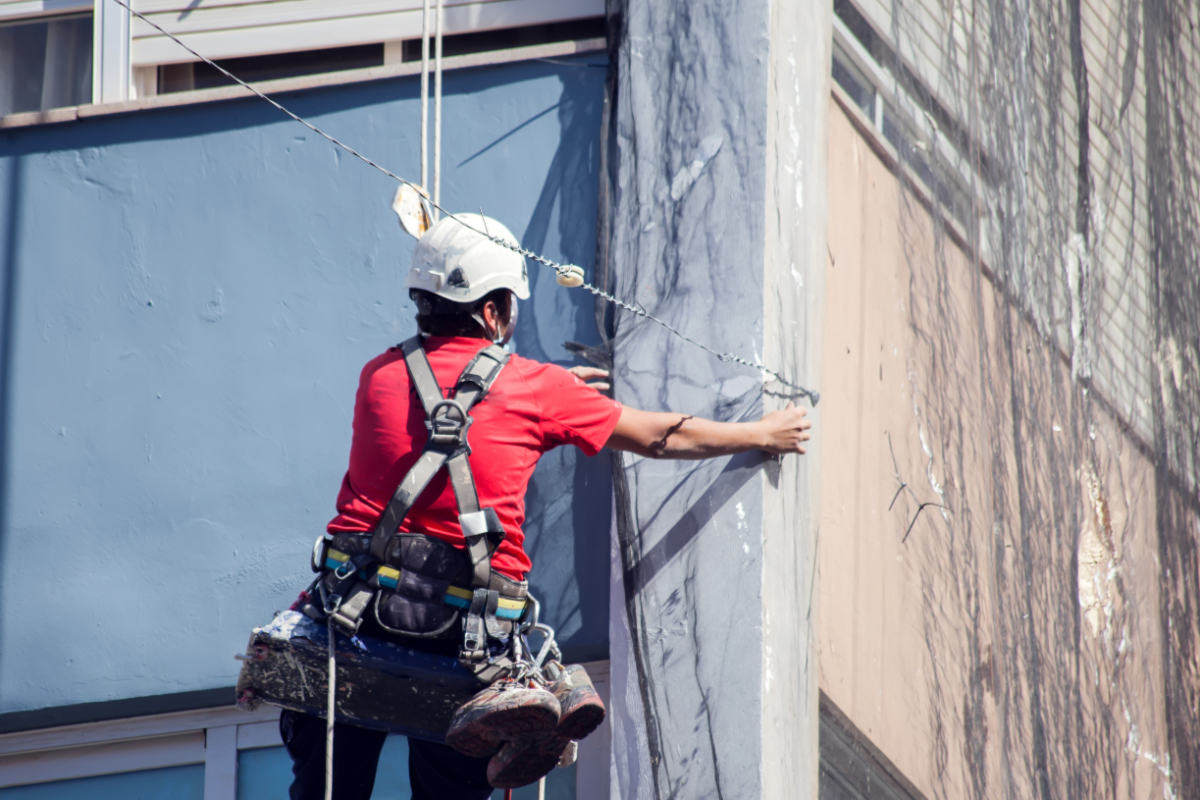
What are the required precautions when working at height? We look at recognising the risks and preparing safety measures when working at height.
Recognising the risks and preparing safety measures
The phrase 'working at height' may make you think of welders up on top of skyscrapers or construction workers wary of dangerous falls but the actual term applies to a lot more common working situations than you may initially realise.
Any job where a worker could fall from a level to a lower level and suffer anything from a small to serious injury is classified as 'working at height'. The exceptions to this are falling down a set of stairs, or slipping and tripping on a single flat level. Working at height can include any of the following:
- Any place where a worker could fall from an edge which standing on a raised platform
- Doing work on fragile areas such as a roof or a floor with a hole underneath
- Working within a confined area
- Working above the ground or floor level
- Working in zones where there is the chance of a worker falling through an opening on an upper level or a ground level. The latter refers to pits, excavations, manholes, etc
Do's and don'ts of working at height
Do
Always assess the location for emergency rescue and evacuation procedures
Protect yourself from potential falling objects
Make sure protective health and safety control measures are in place when working on fragile surfaces
Ensure that your equipment is suitable and of good enough quality for the job at hand.
Equipment should also be maintained and inspected regularly
Secure safe movement from the stable ground to the workplace of height
Always work as much as possible from safe ground
Don't...
Let anyone who isn't of competent skill work at height Use ladders for long, strenuous and heavy jobs.
Only use ladders for lighter work which take minimal time. At most 30 minutes.
Lean ladders against weak surfaces such as plastic drainage pipes
Overreach while using ladders or stepladders
Overload workers while using ladders. Examine the equipment and materials carried by the worker first to make sure they are not too heavy
Height safety precautions
Ladders should only ever be used for jobs or tasks of a short duration. They should always be:
Raised or put up at the correct safe angle. Use the 4 to 1 rule. For every 4 feet of height of the ladder, make sure the base of the ladder is 1 foot away from the wall.
Ensure the ladder is secured. Securing the ladder at the top is a priority but securing at the base can be acceptable too
Position the ladder as close to the work as possible, as to not cause the worker to overreach
Make sure the ladder is protected at the base so that the ladder is not knocked over by pedestrians or even vehicles
Stepladders should always:
Be extended as far as possible and then locked off
Only ever have one worker using the stepladder at a time
Be of the correct grade and quality for the job at hand and the intended use
Never have the tool shelf, top tread, or back of the steps used as foot support for the worker
Whenever a worker is using a mobile elevated work platform, also known as MEWPS, you should:
Make sure that they are wearing a safety harness
Only ever use the platform when on firm, safe and level ground
Always work with a qualified operator who is at ground level
Only ever use equipment which has outriggers and stabilisers
Be constantly assessing the current working conditions to ensure safe working. Take account of wind speeds, power cables, beams and other obstructions.
Scaffolding must always be built and then inspected on a regular basis by a skilled worker with competent skills.
Wherever a worker could potentially fall 2 metres or more, a capable worker should inspect the scaffolding and then keep a record of the scaffolding's condition. Most inspections must also take place at the very least weekly after the scaffolding's construction.
The use of a tagging system is a fantastic way to let workers know which scaffolding structures have been inspected and given the all-clear.
Risk assessments are vital and may lead to more frequent inspections taking place. Risk assessments will also be required after a stint of bad weather or after any kind of modification is made to the scaffolding structure.
Tower scaffolding should always:
Have safe and tested ladder access to the work platform
Follow exactly the manufacturer's guidelines for the height to base ratio
Ensure all casters are thoroughly locked into position before use and must never be relocated while the tower is being used by a worker
Under no circumstances should scaffolding be used while there is a broken part or any kind of fault in the structure. Scaffolding should also never be occupied if there are strong winds.
The additional safety equipment listed below should only be used when all other methods are obsolete and no longer practical. The safety equipment below is a last resort. These pieces of equipment include:
Harnesses for workers
Airbags
Nets
Safety lines
Other equipment used for fall restraint and arrest
These pieces of equipment should only ever be used and set up by workers who are trained and completely competent. The equipment should also be tested and inspected regularly to ensure safety for the workers.
Assessing and planning against risk
No matter what work is being done, the job must always be meticulously planned out in advance in order to ensure safety for every worker involved. The job must be fully supervised and carried out by workers who are competent and know how to act if something goes wrong.
The whole process should start with a risk assessment. If done correctly, this process should highlight any hazards which could hamper the project, as well as any risks. From here, the team can make decisions on the suitable controls. These controls will then make up the support of a method statement for finishing the work.
DO I NEED FALL PROTECTION SAFETY BAGS ON A BUILDING SITE?
During the planning stages of the process, emergency actions and procedures should be discussed, communicated between workers and put into place in case an emergency situation or accident arises while the work is being done. The working platform on the scaffolding should be secure, safe, and also suitable for the type of work being carried out.
Whenever your team is using scaffolding, ensure that it is:
- Constructed by contractors who are completely competent and fully trained
- On solid and level ground. The scaffolding must be secure.
- Completely compliant with all scaffolding regulations when it comes to guard rails, toe boards, etc

Consideration must be given to how the workers will actually get themselves to the work platform. Though a ladder may seem like the obvious solution, it is not always the most appropriate method. Do your workers need stairs? Or even a mobile elevated work platform?
These methods may introduce new risks and hazards so the project may need to be reassessed and replanned in order to make sure an emergency situation doesn't take place.
The most vital part of the process is ensuring that your workers are experienced, capable and fully trained. They should be completely competent when working at heights and completely understand the risks involved.
As well as knowing exactly what to do if an emergency occurs. They should also have a deep understanding of any equipment and controls used in the job process.
If you are working on a construction project in Suffolk, Cambridgeshire, Hertfordshire, Kent or London, you will be considring the safety requirements of your workers. Follow the links below for construction site safety nets, crash bags hire and edge protection hire.
Construction Site Safety Nets Fall Arrest Bags Hire Roof Edge Protection Hire