

Do you want to find out more about the UK edge protection regulations? We look at the UK legal requirements for working at height and when edge protection is required.
What Are UK Edge Protection Regulations

The HSE (Health and Safety Executive) have summarised some of the basic requirements for any roof edge protection. This summarisation is found in their guide to working on roofs.
There are many parts to this protection guide, but the protection should include or at least be equivalent to the main guardrail that is at least 950mm above the edge. It will also include a toe board guard for objects that have some risks of being kicked off the edge of the platform and some number of suitable intermediate guard rails.
Some parts include standards and regulations relating to the roof fall protection guardrail systems. These regulations have been known to cause some confusion. There is no one size fits all, so these must be tested and are determined document by document.
No regulations are targeting free-standing guardrails, which are generally used as either permanent or temporary solutions.

Roof Edge Protection Regulations
As said before, there is a range of standards related to temporary and permanent edge protection that can be found worldwide. Some of the regulations for the UK and Europe include:
The Building Regulations Part K 2013
Workplace Health Safety and Welfare Regulations 1992
HSE Specialist Inspectors Report No 15 1987
BS 6399 Part 1 Loading for Building 1996
HSE Specialist Inspectors Report No 15 1987
The Work at Height Regulations 2005
Construction Health, Safety and Welfare Regulations 1996
BS 6399 Part 2 Code of Practice for Wind Loading 1997
HSE Health and Safety in Roof work 2012
There are some load and testing criteria that they may need to meet for the regulations. The health & safety in roof work is important to keep anyone on the roofs safe with assessments being taken. More standards can be found that cause problems and confusion with individuals trying to specify a guardrail. This is generally because they require different testing and load criteria.
In addition to these standards, there are no specific standards used to deal with cantilevered guardrails. These guardrails are used as both temporary and permanent product solutions. Because of this, it provides extra confusion for some individuals.
UK Legal Requirements
The legal requirement for the UK Building Regulations Part K requires a guardrail to consist of no less than two horizontal rails with a minimum height of 1100mm.
The loading criteria was taken from BS 6399 part 1 1996 Regulation. This requires a guardrail to withstand a distributed weight of around 0.74kN.
Within Part K2 Regulation, a specific heading is called "Guarding of areas used for maintenance". Under this heading, a part states, "If access is required less frequently than once a month, It may be appropriate to use temporary guarding". Most places require permanent means of access depending on the frequency of access needed.
Building Regulations Part K (Protection from falling)
In terms of Part K2 of the Building Regulation, it requires the guarding to be provided where there are:
Any Ramps, Floors (Which form a part of the building), stairs and balconies, and any roof to which people can have access.
Any basement area, light well a sunken area similar to these that are connected to a building.
As stated before, guarding such as edge protection should consist of at least two horizontal rails, and the height must be at least 1100mm.
There is one specific heading in Part K under the application section called "Interaction with other legislation". This relaxes the loadings suggested under the condition that the access is low and controlled.
BS EN 13374
The EN 13374 is a standard and is directly liked to the design of temporary edge protection systems. This standard also requires a system that can withstand loads applied perpendicular, horizontal and vertical for the system.
This standard was initially released and put into action in 1997 and replaced the previous step named H&E Specialist Inspectors Report No 15 1987 and other European Standards. There have been some discussions about changing this title to more accommodating for permanent counterbalanced systems.
For EN 13374, it outlines three classes of the edge protection system.
Unfortunately, the changes suggested never got issued. However, within the UK National Forwards, some clear references can be used and include the permanent counterbalanced systems previously discussed.
The roof pitch class A 0-10°
The roof pitch class B 10-30°
The roof pitch class C 30-45°
Each of these classes has its static load requirements. For classes b and c, they have an added dynamic load applied. This represents a person rolling down the roof slope and making contact with the edge protection system.
Under Clause 7.3, any counterbalanced or friction systems should have some test at the maximum inclination. This should be tested according to the manufacturer's instructions.
The performance of this test will have some variables to consider, such as the base material (also if it is wet or dry), roof pitch and whether or not there is an upstand present. For the manufacturer's side, they must do some tests and demonstrate the compliance standard by testing the various places where they claim their products can be installed.
The Work at Height Regulations 2005
The Work at Height Regulations was introduced in 2005 and required all those involved and responsible for ensuring that all work conducted at height is carried safely. Obviously, this will mean starting with a risk assessment for as many factors as possible. After the required risk assessment has been carried out, any solutions chosen for these risks must be suitable and sufficient to ensure no objects or people will fall from the roof.
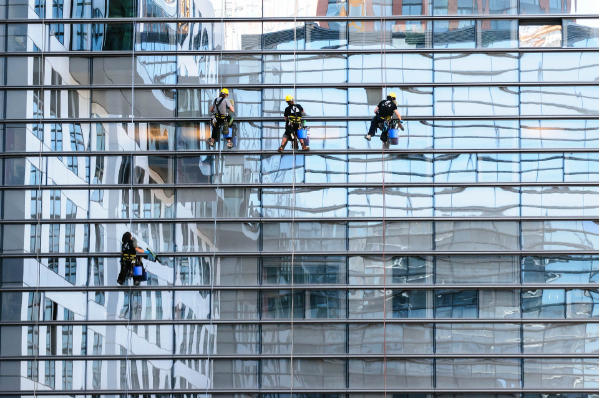
Schedule 2 of these regulations state that any temporary protection provisions, the top guardrail or things of similar means must be at least 950mm high or more.
Also, toe boards must be suitable and sufficient to stop anyone from falling or any materials/objects from falling. The intermediate guardrail or other means of protection must be positioned, so any gap between them and other means of protection does not exceed 470mm.
If you are working on a construction project in Suffolk, Cambridgeshire, Hertfordshire, Kent or London, you will be considring the safety requirements of your workers. Follow the links below for construction site safety nets, crash bags hire and edge protection hire.
Construction Site Safety Nets Crash Bags Hire Edge Protection Hire Suffolk